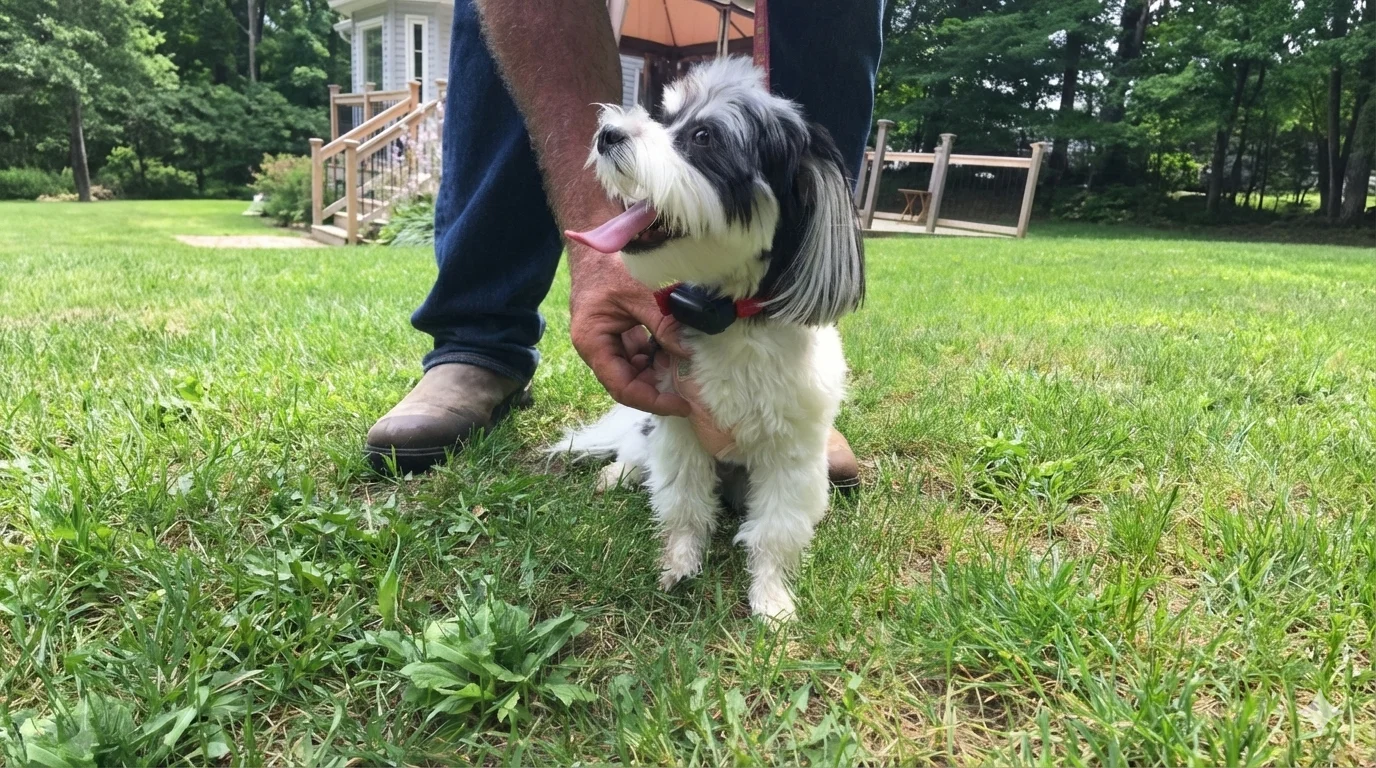
Underground Dog Fence Training Guide
The complete day-by-day plan for teaching your dog to respect their invisible fence boundaries. Safely and confidently, without fear or confusion.
Why GentleSteps™ Works
Dogs don't learn through fear. They learn through clear, consistent communication. Our training method builds confidence, not anxiety. Learn more about how our system works.
Start Low, Go Slow
We begin at correction levels so low most dogs barely notice them, just a mild tingle. This lets your dog learn the beep means "turn around" without any stress or fear.
Positive Reinforcement
Every time your dog hears the beep and retreats, they get praise and treats. They're learning a new skill, not being punished. The correction is just backup.
Gradual Progression
Over 7-10 days, we slowly increase correction levels only as needed. Most dogs never need high levels. They respond to the beep alone within days.
The Day-by-Day Training Plan
Follow this plan as closely as you can. Consistency is key. Most dogs are reliably trained within 7-10 days, though some learn faster and a few need more time.
Introduction Phase
Days 1-2 • 2-3 short sessions per day • 10-15 minutes each
Your goal is simple: teach your dog that the beep means "turn around and come back." At this stage, the correction is set to the lowest level, barely perceptible.
Put the collar on your dog and attach a 15-20 foot leash. Walk toward the boundary flags. When your dog hears the beep, use the leash to gently guide them back toward the safe zone. The moment they turn around, give enthusiastic praise and a treat.
Session Checklist:
- Approach boundary from different directions each time
- Let your dog hear the beep, then guide them back
- Praise and treat immediately when they retreat
- Keep sessions short. End on a positive note
- Remove collar after each session (never leave it on 24/7)
Tip: High-value treats work best. Use something your dog doesn't get at other times: small pieces of chicken, cheese, or freeze-dried liver.
Reinforcement Phase
Days 3-4 • 2-3 sessions per day • 15-20 minutes each
Now we add mild distractions. Your dog should be starting to turn away from the boundary on their own when they hear the beep. If they're not responding consistently, don't worry, keep practicing.
Continue on-leash, but give your dog a bit more slack. Have family members walk on the other side of the boundary. Roll a ball toward (but not past) the flags. Watch how your dog responds.
Session Checklist:
- Give more leash slack to let your dog make choices
- Add mild distractions (family members, toys)
- Watch for self-correction (turning away without leash guidance)
- Continue praise and treats for every retreat
- If needed, slightly increase correction level (one step only)
Important: Do not allow off-leash freedom yet, even if your dog seems to understand. It's too early.
Distraction Phase
Days 5-6 • 2-3 sessions per day • 15-20 minutes each
Time to test your dog's understanding with real-world temptations. This is the most challenging part of training, but it's essential. A dog that respects the boundary with no distractions may still chase a squirrel right through it.
Still on-leash, introduce stronger distractions: have someone walk a friendly dog past the boundary, toss a ball outside the flags, or time your session when you know the mail carrier is coming.
Session Checklist:
- Test with high-value distractions (other dogs, squirrels, delivery trucks)
- Stay on-leash. You need to be able to intervene
- If your dog ignores the beep and lunges toward a distraction, use the leash to stop them
- Increase correction level if needed to match your dog's drive
- Celebrate successful self-corrections with extra enthusiasm
Tip: If your dog consistently ignores the beep when a specific distraction appears (deer, neighbor's cat), contact us. We may need to remove the half-second delay or adjust settings.
Supervised Freedom
Day 7+ • Multiple supervised sessions • Gradually longer
Your dog should now be self-correcting consistently: hearing the beep, turning around, and coming back to the safe zone without leash guidance. Time for the first taste of off-leash freedom.
Remove the leash but stay outside with your dog. Watch closely. If they approach the boundary and self-correct, praise them. If they linger at the boundary without retreating, calmly call them back. Keep initial off-leash sessions short (10-15 minutes) and stay present.
Graduation Checklist:
- Dog self-corrects at least 5 times in a row with distractions present
- Dog no longer needs leash guidance at all
- Dog retreats immediately when beep sounds (no hesitation)
- Dog seems relaxed, not anxious, while wearing the collar
Don't rush this step. If your dog still needs occasional reminders, go back to Step 3 for a few more days. It's better to train for 10 days than to have a dog run through the boundary.
After Training: Removing the Flags
Days 10-14 • Gradual removal over 3-5 days
Once your dog is reliably trained, start removing the boundary flags gradually. Don't remove them all at once. Your dog has learned to associate the flags with "stop here."
Remove every other flag on day one. Wait two days. If your dog still respects the boundary, remove half of the remaining flags. Continue until all flags are gone.
Flag Removal Schedule:
- Day 1: Remove every other flag
- Day 3: Remove half of remaining flags
- Day 5: Remove rest of flags
- If dog seems confused at any point, put some flags back temporarily
Long-term tip: Store your flags somewhere accessible. If you ever need to retrain (after a long absence, a move, or adding a new dog), you'll want them again.
Common Training Mistakes
These are the errors we see most often. Avoid them and your training will go much more smoothly. We also cover the 5 mistakes new invisible fence owners make in more detail on the blog.
✗ Skipping to Off-Leash Too Soon
Your dog seems to get it, so you let them off-leash on day 3. They chase a squirrel straight through the boundary. Now they know they can escape.
✗ Training Too Long
You want to get it done, so you train for 45 minutes straight. Your dog gets exhausted, frustrated, and starts ignoring the boundary.
✗ Leaving the Collar On 24/7
You figure the collar should always be on for safety. Your dog develops pressure sores on their neck from the contact points.
✗ Punishing at the Boundary
Your dog crosses the boundary, so you scold them or drag them back. Now they're afraid of the whole yard.
✗ Inconsistent Daily Training
You train on Monday, skip Tuesday through Thursday, then try again Friday. Your dog forgets what they learned.
✗ Starting at High Correction Levels
You want to make sure your dog "gets the message," so you start at a high correction. Your dog becomes afraid of the entire yard.
Troubleshooting During Training
Things don't always go according to plan. Here's how to handle common issues. For more answers, see our FAQ.
My dog is afraid to go outside
This usually means the correction level is too high, or training moved too fast. Your dog has associated the yard with discomfort instead of learning where the boundary is.
What to do:
- Stop training for 2-3 days. Let your dog relax.
- Spend time in the yard with the collar off, playing, giving treats, making it positive again.
- When you restart, lower the correction level significantly.
- Stay far from the boundary initially. Rebuild confidence slowly.
- If the fear persists, call us. We can help adjust settings and strategy.
My dog ignores the beep and runs through
Either the correction level is too low for your dog's temperament, or the distraction is too tempting. This is common with high-prey-drive dogs chasing wildlife.
What to do:
- Go back to on-leash training immediately.
- Increase the correction level by 1-2 steps.
- Practice specifically with the distraction that caused the run-through.
- If your dog is sprinting through at full speed, call us. We may need to remove the half-second delay.
My dog won't go near the boundary at all
Some dogs become over-cautious and stay far from the boundary, shrinking their safe zone unnecessarily.
What to do:
- This often resolves naturally over 2-3 weeks as your dog gains confidence.
- Play with your dog closer to the boundary (but inside the safe zone).
- Toss treats toward the flags so your dog learns the safe zone includes that area.
- If the behavior persists, we can adjust the signal field to give your dog more warning distance.
My dog tested the boundary once and now refuses to wear the collar
The dog is associating the collar itself with the correction. This is a sign training may have been too intense.
What to do:
- Take a break from training for a few days.
- Put the collar on (turned off) and immediately give treats. Repeat several times.
- Gradually build positive associations: collar = treats, play, walks.
- When you resume, keep the correction level low and sessions short.
Still having trouble? Call us at 855-364-3362. Training support is free, forever. We've trained nearly 2,000 dogs. We've seen it all. You can also visit our troubleshooting page for quick fixes.
Training Stubborn & High-Drive Dogs
Some dogs are more determined than others. If your dog has high prey drive, is a known escape artist, or has a stubborn personality, training may require extra steps.
Breeds That Often Need Extra Attention
Every dog is an individual, but we see certain breeds more frequently in the "challenging" category:
These dogs often have strong prey drive, independent thinking, or were bred to work away from their owners. They can absolutely be trained. They just need a firmer approach.
What Makes Training Harder
A dog that will ignore mild discomfort to chase a deer is different from a dog that stops the moment they hear the beep. For determined dogs, the correction needs to be noticeable enough to interrupt their focus, even when a squirrel is running past.
Our Track Record
Since 2009, we've only had 5 dogs out of nearly 2,000 that we couldn't contain. All of them were extreme cases. If you follow the training and work with us on settings, we'll find a solution that works for your dog.
Training Puppies
Good news: puppies often learn faster than adult dogs because they don't have escape habits to unlearn.
We can start training puppies as young as 12 weeks old (about 3 months), depending on their size and temperament. Smaller or more timid puppies may benefit from waiting until 4-5 months.
Puppies start at correction level 0, just the beep, no correction at all. We increase the level more slowly than with adult dogs, typically every other day instead of daily. The goal is gentle, consistent exposure to the concept of boundaries.
Shorter Sessions
Puppies have short attention spans. Keep training sessions to 5-10 minutes. You can do more sessions per day to compensate.
More Treats
Puppies are highly food-motivated. Use lots of small, high-value treats. Make every retreat from the boundary a celebration.
Patience with Regression
Puppies may "forget" lessons overnight. Don't worry, this is normal. They'll get it with repetition.
Collar Fit Checks
Puppies grow fast. Check collar fit weekly and adjust as needed. The contacts should touch the skin but not dig in.
One advantage of training puppies: they grow up respecting the boundary as a normal part of life. Dogs trained as puppies rarely challenge the fence as adults.
Tips for Training Success
Same Time Each Day
Dogs thrive on routine. Training at consistent times helps your dog anticipate and prepare for sessions.
End on Success
Always end sessions with a successful retreat from the boundary, followed by praise and a treat.
Whole Family Involved
Everyone who interacts with the dog should understand the training. Mixed signals confuse dogs.
Train When Calm
An over-excited or over-tired dog won't learn well. Train when your dog is alert but relaxed.
Keep Notes
Track which distractions challenge your dog and what correction level you're at. Patterns emerge.
Call Early
If something isn't working, don't wait. Call us on day 3, not day 10. Early adjustments prevent frustration.
When to Contact Us
Training support is free, forever. Don't hesitate to reach out. That's what we're here for.
✓ Normal Questions (Give Us a Call)
- What correction level should I move to next?
- How do I know when my dog is ready for off-leash?
- My dog seems hesitant. Is this normal?
- How tight should the collar be?
- Can I take my dog for a walk outside the boundary?
- The collar battery seems to drain quickly
Call Us Right Away
- My dog ran through the boundary at full speed
- My dog is afraid to go outside or wear the collar
- I see redness or sores on my dog's neck
- The transmitter is beeping (wire break)
- My dog ignores the correction even at high levels
- I'm feeling frustrated and don't know what to do
We answer calls 7 days a week during business hours.
Training questions don't cost extra. Support is included for life.
Training FAQ
How long does training take?
Most dogs are reliably trained in 7-10 days. Puppies and high-drive dogs may take 2-3 weeks. A few dogs learn in just 4-5 days.
Can I hire someone to train my dog?
We include initial training on install day. If you need additional in-person sessions, we offer follow-up training for a fee. Your first revisit within 30 days is free.
My old dog was never trained. Can I start now?
Dogs of any age can learn. Older dogs may take slightly longer, but we've successfully trained senior dogs many times.
Do I need to retrain after vacation?
Usually not, but if your dog has been away for several weeks, do a few refresher sessions before leaving them unsupervised.
How do I walk my dog outside the boundary?
Remove the collar before leaving. Your dog will learn: collar on = boundary active. We teach you an exit routine during installation.
What if I have multiple dogs?
Train them separately at first so you can focus on each dog's progress. Once both are trained, they can be in the yard together.
Should I leave the collar on when my dog is inside?
No. Remove the collar whenever your dog is inside or supervised. Dogs should only wear the collar when they're in the yard unsupervised.
My dog got out once. Do I need to start over?
Not from scratch, but go back to on-leash training for a few days. Figure out what caused the escape (distraction? low correction?) and address it.
Ready to Get Started?
Our professional installation includes hands-on training to set you and your dog up for success.
Get Your Free QuoteAlready a customer? Need training help? Call 855-364-3362